%20-%20Copy.png)
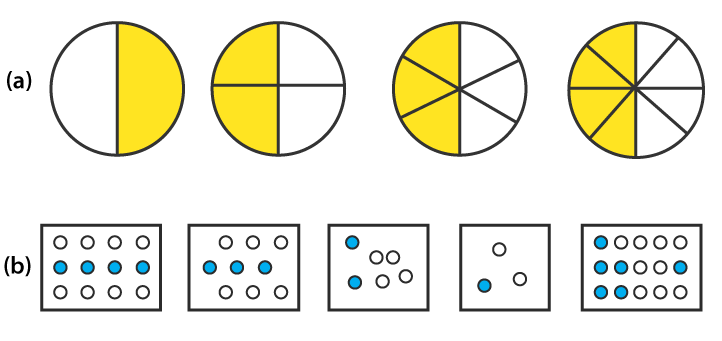
1. Write the fractions. Are all these fractions equivalent?
Solutions:
(a)
(i) The shaded portion is \(\dfrac{1}{2}\).
(ii) The shaded portion is \(\dfrac{2}{4} = \dfrac{1}{2}\).
(iii) The shaded portion is \(\dfrac{3}{6} = \dfrac{1}{2}\).
(iv) The shaded portion is \(\dfrac{4}{8} = \dfrac{1}{2}\).
Hence, all fractions are equivalent.
(b)
(i) The shaded portion is \(\dfrac{4}{12} = \dfrac{1}{3}\)
(ii)The shaded portion is \(\dfrac{3}{9} = \dfrac{1}{3}\)
(iii) The shaded portion is \(\dfrac{2}{6} = \dfrac{1}{3}\)
(iv) The shaded portion is \(\dfrac{1}{3}\)
(v) The shaded portion is \(\dfrac{6}{15} = \dfrac{2}{5}\)
All the fractions in their simplest form are not equal
Hence, they are not equivalent fractions.
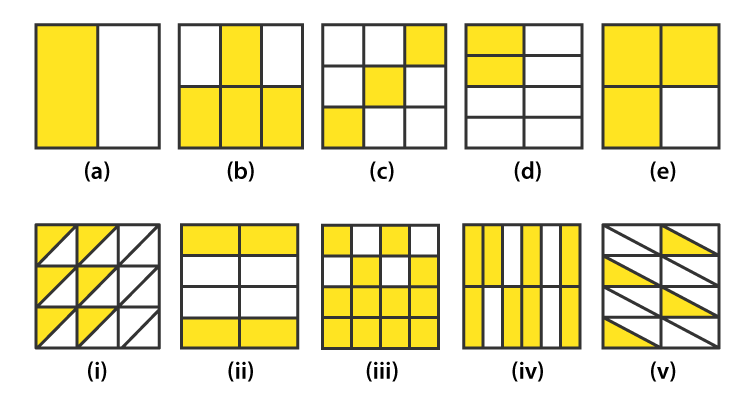
2. Write the fractions and pair up the equivalent fractions from each row.
Solutions:
(ii)The shaded portion is \(\dfrac{3}{9} = \dfrac{1}{3}\)
(iii) The shaded portion is \(\dfrac{2}{6} = \dfrac{1}{3}\)
(iv) The shaded portion is \(\dfrac{1}{3}\)
(v) The shaded portion is \(\dfrac{6}{15} = \dfrac{2}{5}\)
All the fractions in their simplest form are not equal
Hence, they are not equivalent fractions.
2. Write the fractions and pair up the equivalent fractions from each row.
Solutions:
(a) \(\dfrac{1}{2}\)
(b) \(\dfrac{4}{6}=\dfrac{2}{3}\)
(c) \(\dfrac{3}{9}=\dfrac{1}{3}\)
(d) \(\dfrac{2}{8}=\dfrac{1}{4}\)
(e) \(\dfrac{3}{4}\)
(i) \(\dfrac{6}{18}=\dfrac{1}{3}\)
(ii) \(\dfrac{4}{8}=\dfrac{1}{2}\)
(iii) \(\dfrac{12}{16}=\dfrac{3}{4}\)
(iv) \(\dfrac{8}{12}=\dfrac{2}{3}\)
(v) \(\dfrac{4}{16}=\dfrac{1}{4}\)
The following are the equivalent fractions
(a) and (ii) = \(\dfrac{1}{2}\)
(b) and (iv) = \(\dfrac{2}{3}\)
(c) and (i) = \(\dfrac{1}{3}\)
(d) and (v) = \(\dfrac{1}{4}\)
(e) and (iii) = \(\dfrac{3}{4}\)
(b) \(\dfrac{4}{6}=\dfrac{2}{3}\)
(c) \(\dfrac{3}{9}=\dfrac{1}{3}\)
(d) \(\dfrac{2}{8}=\dfrac{1}{4}\)
(e) \(\dfrac{3}{4}\)
(i) \(\dfrac{6}{18}=\dfrac{1}{3}\)
(ii) \(\dfrac{4}{8}=\dfrac{1}{2}\)
(iii) \(\dfrac{12}{16}=\dfrac{3}{4}\)
(iv) \(\dfrac{8}{12}=\dfrac{2}{3}\)
(v) \(\dfrac{4}{16}=\dfrac{1}{4}\)
The following are the equivalent fractions
(a) and (ii) = \(\dfrac{1}{2}\)
(b) and (iv) = \(\dfrac{2}{3}\)
(c) and (i) = \(\dfrac{1}{3}\)
(d) and (v) = \(\dfrac{1}{4}\)
(e) and (iii) = \(\dfrac{3}{4}\)
3. Replace ☐ in each of the following by the correct number:
(a) \(\dfrac{2}{7} = \dfrac{8 }{ ☐}\)
\(☐ = \dfrac{7 × 8}{ 2}\)
= 28
(b) \(\dfrac{5}{8} = \dfrac{10 }{ ☐}\)
\(☐ = \dfrac{8 × 10}{ 5}\)
= 16
(c) (c) \(\dfrac{3}{5} =\dfrac{ ☐}{ 20}\)
\(☐ = \dfrac{3 × 20}{ 5}\)
= 12
(d) \(\dfrac{45}{60} = \dfrac{15 }{ ☐}\)
\(☐ = \dfrac{15 × 60}{45}\)
= 20
(e) \(\dfrac{18}{24} = \dfrac{ ☐}{4}\)
\(☐ = \dfrac{18 × 4}{24}\)
= 3
4. Find the equivalent fraction of \(\dfrac{3}{5}\) having
(a) denominator 20
Let M be the numerator of the fractions
\(\dfrac{ M}{ 20} =\dfrac{ 3}{5}\)
5 × M = 20 × 3
\(M =\dfrac{20 × 3}{5}\)
= 12
Therefore, the required fraction is \(\dfrac{12}{20}\)
(b) numerator 9
Let N be the denominator of the fractions
∴ \(\dfrac{9 }{ N} = \dfrac{3}{ 5}\)
3 × N = 9 × 5
N = \(\dfrac{9 × 5}{3}\)
= 15
Therefore, the required fraction is \(\dfrac{9}{15}\)
(c) denominator 30
Let D be the numerator of the fraction
∴ \(\dfrac{D }{30} = \dfrac{3 }{ 5}\)
5 × D = 3 × 30
D = \(\dfrac{3 × 30}{5}\)
= 18
Therefore, the required fraction is \(\dfrac{18}{30}\)
(d) numerator 27
Let N be the denominator of the fraction
∴ \(\dfrac{27 }{ N} = \dfrac{3 }{ 5}\)
3 × N = 5 × 27
N =\(\dfrac{5 × 27}{ 3}\)
= 45
Therefore, the required fraction is \(\dfrac{27}{45}\)
5. Find the equivalent fraction of \(\dfrac{36}{48}\) with
(a) numerator 9
(b) denominator 4
Solutions:
(a) Given numerator = 9
∴ \(\dfrac{9 }{D} = \dfrac{36 }{48}\)
D × 36 = 9 × 48
D = \(\dfrac{9 × 48}{36}\)
D = 12
Hence, the equivalent fraction is \(\dfrac{9 }{12}\)
(b) Given, denominator = 4
∴\( \dfrac{N }{ 4} = \dfrac{36 }{ 48}\)
N × 48 = 4 × 36
N = \(\dfrac{4 × 36) }{ 48}\)
Hence, the equivalent fraction is \(\dfrac{3}{4}\)
6. Check whether the given fractions are equivalent:
(a) \(\dfrac{5}{ 9},\dfrac{ 30 }{ 54}\)
\(\dfrac{ 30 }{ 54}=\dfrac{5}{ 9}\)
\(\dfrac{ 5 }{ 9}=\dfrac{5}{ 9}\)
(b) \(\dfrac{3 }{10},\dfrac{12}{ 50}\)
\(\dfrac{12 }{ 50}=\dfrac{6 }{ 25}\)
\(\dfrac{3 }{ 10}\neq\dfrac{6 }{ 25}\)
Hence, \(\dfrac{3 }{10},\dfrac{12}{ 50}\) are not equivalent fractions.
(c) \(\dfrac{7 }{ 13},\dfrac{5 }{ 11}\)
\(\dfrac{7 }{ 13}\neq\dfrac{5 }{ 11}\)
Hence, \(\dfrac{7 }{ 13},\dfrac{5 }{ 11}\) are not equivalent fractions.
Hence, \(\dfrac{7 }{ 13},\dfrac{5 }{ 11}\) are not equivalent fractions.
7. Reduce the following fractions to simplest form:
(a) \(\dfrac{48 }{ 60}=\dfrac{4}{5}\)
(b) \(\dfrac{150 }{ 60}=\dfrac{5}{2}\)
(c) \(\dfrac{84 }{ 98}=\dfrac{6}{7}\)
(d) \(\dfrac{12 }{ 52}=\dfrac{3}{13}\)
(e) \(\dfrac{7 }{ 28}=\dfrac{1}{4}\)
(a) \(\dfrac{48 }{ 60}=\dfrac{4}{5}\)
(b) \(\dfrac{150 }{ 60}=\dfrac{5}{2}\)
(c) \(\dfrac{84 }{ 98}=\dfrac{6}{7}\)
(d) \(\dfrac{12 }{ 52}=\dfrac{3}{13}\)
(e) \(\dfrac{7 }{ 28}=\dfrac{1}{4}\)
8. Ramesh had \(20\) pencils, Sheelu had \(50\) pencils and Jamaal had \(80\) pencils. After \(4\) months, Ramesh used up \(10\) pencils, Sheelu used up \(25\) pencils and Jamaal used up \(40\) pencils. What fraction did each use up? Check if each has used up an equal fraction of her/his pencils.
Solutions:
Total number of pencils Ramesh had = 20
Number of pencils used by Ramesh = 10
∴ Fraction = \(\dfrac{10 }{20} = \dfrac{1 }{ 2}\)
Total number of pencils Sheelu had = 50
Number of pencils used by Sheelu = 25
∴ Fraction = \(\dfrac{25 }{50} = \dfrac{1 }{ 2}\)
Total number of pencils Jamaal had = 80
Number of pencils used by Jamaal = 40
∴ Fraction = \(\dfrac{40}{80} = \dfrac{1 }{ 2}\)
Yes, each has used up an equal fraction of pencils i.e \(\dfrac{1 }{ 2}\).
(i) \( \dfrac{250}{400} = \dfrac{5}{8}\) → (d)
(ii) \( \dfrac{180}{200} = \dfrac{9}{10} \) → (e)
(iii) \( \dfrac{660}{990} = \dfrac{2}{3} \) → (a)
(iv) \( \dfrac{180}{360} = \dfrac{1}{2} \) → (c)
(v) \( \dfrac{220}{550}= \dfrac{2}{5} \) → (b)
✅ Final Matching:
(i) → (d)
(ii) → (e)
(iii) → (a)
(iv) → (c)
(v) → (b)


.png)
.png)
%20-%20Copy.png&description=Class 6 Fractions Ex 7.3)
0 Comments