
1. Find the circumference of the circle with the following radius. (Take \(π = \dfrac{22}{7}\))
(a) 14 cm
Solution:-
The radius of the circle = 14 cm
Circumference of the circle = 2πr
\(= 2 × \dfrac{22}{7} × 14 \)
= 2 × 22 × 2
= 88 cm
(b) 28 mm
Solution:-
The radius of the circle = 28 mm
Circumference of the circle = 2πr
\(= 2 × \dfrac{22}{7}× 28 \)
= 2 × 22 × 4
= 176 mm
(c) 21 cm
Solution:-
The radius of the circle = 21 cm
Circumference of the circle = 2πr
\(= 2 ×\dfrac{22}{7} × 21\)
= 2 × 22 × 3
= 132 cm
2. Find the area of the following circles, given that
(a) Radius = 14 mm (Take \(π = \dfrac{22}{7}\))
Solution:
The radius of the circle = 14 mm
Area of the circle \(= πr^2\)
\(=\dfrac{22}{7} × 142\)
\(= \dfrac{22}{7} × 196\)
= 22 × 28
= 616 mm\(^2\)
(b) Diameter = 49 m
Solution:
The diameter of the circle (d) = 49 m
We know that radius (r) = \(\dfrac{d}{2}\)
= \(\dfrac{49}{2}\)
= 24.5 m
Area of the circle = πr\(^2\)
= \(\dfrac{22}{7} × (24.5)^2\)
=\( \dfrac{22}{7} × 600.25\)
= 22 × 85.75
= 1886.5 m\(^2\)
(c) Radius = 5 cm
Solution:
The radius of the circle = 5 cm
Area of the circle = πr\(^2\)
= \(\dfrac{22}{7} × 5^2\)
= \(\dfrac{22}{7} × 25\)
=\(\dfrac{550}{7} \)
= 78.57 cm\(^2\)
3. If the circumference of a circular sheet is 154 m, find its radius. Also, find the area of the sheet. (Take \(\pi = \dfrac{22}{7}\)).
Solution:-
Circumference of the circle = 154 m
The circumference of the circle = 2πr
\(154 = 2 × (\dfrac{22}{7}) × r\)
\(154 = \dfrac{44}{7} × r\)
\(r = \dfrac{(154 × 7)}{44}\)
\(r = \dfrac{(14 × 7)}{4}\)
\(r = \dfrac{49}{2}\)
r = 24.5 m
Area of the circle = πr\(^2\)
\(= \dfrac{22}{7} × (24.5)^2\)
\(= \dfrac{22}{7} × 600.25\)
\(= 22 × 85.75\)
\(= 1886.5\) m\(^2\)
So, the radius of the circle is 24.5, and the area of the circle is 1886.5.
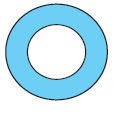
4. A gardener wants to fence a circular garden of diameter 21m. Find the length of the rope he needs to purchase, if he makes 2 rounds of the fence. Also, find the cost of the rope, if it costs ₹ 4 per meter. (Take \(π = \dfrac{22}{7}\))
Solution:-
Diameter of the circular garden = 21 m
We know that radius (r) = d/2
=\( \dfrac{21}{2}\)
= 10.5 m
Circumference of the circle = 2πr
=\( 2 × \dfrac{22}{7} × 10.5\)
= \(\dfrac{462}{7}\)
= \(66\) m
So, the length of rope required = \(2 × 66 = 132\) m
Cost of \(1\) m rope = ₹ 4 [given]
Cost of \(132\) m rope = ₹ \(4 × 132\)
= ₹ \(528\)
5. From a circular sheet of radius 4 cm, a circle of radius 3 cm is removed. Find the area of the remaining sheet. (Take π = 3.14)
Solution:-
Radius of circular sheet R = 4 cm
A circle of radius to be removed \(r = 3\) cm
The area of the remaining sheet = πR\(^2\) – πr\(^2\)
= \(π (R^2 – r^2\))
= \(3.14 (4^2 – 3^2)\)
= \(3.14 (16 – 9)\)
= \(3.14 × 7\)
= \(21.98\) cm\(^2\)
So, the area of the remaining sheet is \(21.98\) cm\(^2\).
6. Saima wants to put lace on the edge of a circular table cover of diameter \(1.5\) m. Find the length of the lace required, and also, find its cost if one meter of the lace costs ₹ \(15\). (Take \(π = 3.14\))
Solution:-
Diameter of the circular table = \(1.5\) m
We know that radius (r) = \(\dfrac{d}{2}\)
= \(\dfrac{1.5}{2}\)
= \(0.75\) m
Circumference of the circle = \(2πr\)
= \(2 × 3.14 × 0.75\)
=\( 4.71\) m
So, the length of the lace =\( 4.71\) m
Cost of \(1\) m lace = ₹ 15\) [given]
Cost of \(4.71\) m lace = ₹ 15 × 4.71\)
= ₹ \(70.65\)
7. Find the perimeter of the adjoining figure, which is a semicircle, including its diameter.

Solution:-
Diameter of semi-circle = 10 cm
We know that radius (r) = \(\dfrac{d}{2}\)
= \(\dfrac{10}{2}\)
= \(5\) cm
Circumference of the semi-circle =\( πr + 2r\)
= \(3.14(5) + 2(5)\)
= \(5 [3.14+ 2]\)
= \(5 [5.14]\)
Therefore, the perimeter of the semicircle = \(25.7\) cm
8. Find the cost of polishing a circular table top of diameter 1.6 m, if the rate of polishing is ₹\(15\)/m\(^2\). (Take π = 3.14)
Solution:-
Diameter of the circular table-top = 1.6 m
We know that radius (r) = \(\dfrac{d}{2}\)
= \(\dfrac{1.6}{2}\)
= 0.8 m
Area of the circular table-top = πr\(^2\)
= 3.14 × 0.82
= 3.14 × 0.8 ×0.8
= 2.0096 m\(^2\)
Cost for polishing 1 m\(^2\) area = ₹ 15 [given]
Cost for polishing 2.0096 m\(^2\) area = ₹ 15 × 2.0096
= ₹ 30.144
Hence, the cost of polishing 2.0096 m\(^2\) area is ₹ 30.144.
9. Shazli took a wire of length 44 cm and bent it into the shape of a circle. Find the radius of that circle. Also, find its area. If the same wire is bent into the shape of a square, what will be the length of each of its sides? Which figure encloses more area, the circle or the square? (Take π = 22/7)
Solution:-
Length of wire that Shazli took =44 cm
If the wire is bent into a circle,
The circumference of the circle = \(2πr\)
\(44 = 2 × (\dfrac{22}{7}) × r\)
\(44 = \dfrac{44}{2}\) × r\)
\(\dfrac{(44 × 7)}{44} = r\)
\(r = 7\) cm
Area of the circle = \(πr^2\)
\(= \dfrac{22}{7} × 7^2\)
\(= \dfrac{22}{7} × 7 ×7\)
\(= 22 × 7\)
= 154 cm\(^2\)
If the wire is bent into a square,
The length of each side of the square = \dfrac{44}{4}\)
= 11 cm
Area of the square = Length of the side of square\(^2\)
= \(11^2\)
= 121 cm\(^2\)
By comparing the two areas of the square and circle,
Clearly, the circle encloses more area.
10. From a circular card sheet of radius 14 cm, two circles of radius 3.5 cm and a rectangle of length 3 cm and breadth 1cm are removed. (As shown in the adjoining figure.) Find the area of the remaining sheet. (Take \(π = \dfrac{22}{7}\))

Solution:-
Radius of the circular card sheet = 14 cm
Radius of the two small circles = 3.5 cm
Length of the rectangle = 3 cm
Breadth of the rectangle = 1 cm
First, we have to find out the area of the circular card sheet, two circles and the rectangle to find out the remaining area.
Area of the circular card sheet = πr\(^2\)
=\( \dfrac{22}{7} × 14^2\)
= \(\dfrac{22}{7} × 14 × 14\)
= \(22 × 2 × 14\)
= 616 cm\(^2\)
Area of the 2 small circles \(= 2 × πr^2\)
\(= 2 × (\dfrac{22}{7} × 3.52)\)
\(= 2 × (\dfrac{22}{7} × 3.5 × 3.5)\)
\(= 2 × ((\dfrac{22}{7}) × 12.25)\)
\(= 2 × 38.5\)
= \(77\) cm\(^2\)
Area of the rectangle = Length × Breadth = 3 × 1 = 3 cm\(^2\)
The area of the remaining part = Card sheet area – (Area of two small circles + Rectangle area)
=\( 616 – (77 + 3)\)
=\( 616 – 80\)
= \(536\) cm\(^2\)
11. A circle of radius 2 cm is cut out from a square piece of an aluminium sheet of side
6 cm. What is the area of the leftover aluminium sheet? (Take π = 3.14)
Solution:-
Radius of circle = 2 cm
Square sheet side = 6 cm
First, we have to find out the area of the square aluminium sheet and circle to find out the remaining area.
Area of the square = side\(^2\) = 6\(^2\)= 36 cm\(^2\)
Area of the circle = πr\(^2\)
= 3.14 × 22
= 3.14 × 2 × 2
= 3.14 × 4
= 12.56 cm\(^2\)
The area of the remaining part = Area of the aluminium square sheet – The area of the circle
= 36 – 12.56
= 23.44 cm\(^2\)
12. The circumference of a circle is \(31.4\) cm. Find the radius and the area of the circle. (Take \(π = 3.14\))
Solution:-
Circumference of a circle = \(31.4\) cm
Circumference of a circle = \(2πr\)
\(31.4 = 2 × 3.14 × r\)
\(31.4 = 6.28 × r\)
\(\dfrac{31.4}{6.28} = r\)
\(r = 5\) cm
Area of the circle \(= πr^2\)
\(= 3.14 × 5^2\)
\(= 3. 14 × 25\)
\(= 78.5\) cm
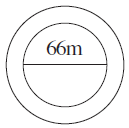
13. A circular flower bed is surrounded by a path 4 m wide. The diameter of the flower bed is 66 m. What is the area of this path? (π = 3.14)
Solution:-
Diameter of the flower bed = 66 m
Radius of the flower bed = \(\dfrac{d}{2}\)
= \(\dfrac{66}{2}\)
= 33 m
Area of flower bed = πr\(^2\)
= 3.14 × 332
= 3.14 × 1089
= 3419.46 m
Now, we have to find the area of the flower bed and path together.
So, the radius of the flower bed and path together = 33 + 4 = 37 m
Area of the flower bed and path together = πr\(^2\)
= \(3.14 × 372\)
= \(3.14 × 1369\)
= \(4298.66\) m
Area of the path = Area of the flower bed and path together – Area of the flower bed
= \(4298.66 – 3419.46\)
= \(879.20\) m\(^2\)
14. A circular flower garden has an area of 314 m\(^2\). A sprinkler at the centre of the garden can cover an area that has a radius of \(12\) m. Will the sprinkler water the entire garden? (Take \(π = 3.14\))
Solution:-
Area of the circular flower garden = 314 m\(^2\)
The sprinkler at the centre of the garden can cover an area that has a radius = 12 m
Area of the circular flower garden = πr\(^2\)
314 = 3.14 × r\(^2\)
\(\dfrac{314}{3.14} = r^2\)
\(r^2 = 100\)
\(r = \sqrt{100}\)
\(r = 10\) m
∴ Radius of the circular flower garden is \(10\) m.
The sprinkler can cover an area of a radius of \(12\) m.
Hence, the sprinkler will water the whole garden.
15. Find the circumference of the inner and the outer circles, shown in the adjoining figure? (Take π = 3.14)

Solution:-
Radius of inner circle = outer circle radius – 10
= \(19 – 10\)
=\( 9\) m
Circumference of the inner circle = \(2πr\)
= \(2 × 3.14 × 9\)
= \(56.52\) m
Radius of outer circle = \(19\) m
Circumference of the outer circle = \(2πr\)
= \(2 × 3.14 × 19\)
= \(119.32\) m
Solution:-
Radius of the wheel = \(28\) cm
Circumference of the wheel = \(2πr\)
= \(2 × \dfrac{22}{7} × 28\)
= \(2 × 22 × 4\)
= \(176\) cm
Now, we have to find the number of rotations of the wheel.
= \(\dfrac{\text{Total distance to be covered}}{ \text{Circumference of the wheel}}\)
= \(\dfrac{352 \text{m}}{176 \text{cm}}\)
= \(\dfrac{35200 \text{cm}}{176 \text{cm}}\)
= \(200\)
17. The minute hand of a circular clock is \(15\) cm long. How far does the tip of the minute hand move in \(1\) hour? (Take \(π = 3.14\))
Solution:-
Length of the minute hand of the circular clock = \(15\) cm
Distance travelled by the tip of minute hand in \(1\) hour = Circumference of the clock
= \(2πr\)
= \(2 × 3.14 × 15\)
= \(94.2\) cm


.png)

0 Comments