
1.The shape of the top surface of a table is a trapezium. Find its area if its parallel sides are 1 m and 1.2 m and perpendicular distance between them is 0.8 m.

Solution:
One parallel side of the trapezium (a) = 1 m
And second side (b) = 1.2 m and
height (h) = 0.8 m
Area of top surface of the table = \({1\over 2}×(a+b)h\)
=\({1\over 2}×((1+1.2)0.8\)
= \({1\over 2}\times 2.2\times 0.8 = 0.88\)
Area of top surface of the table is \(0.88 \text{m}^2\) .
And second side (b) = 1.2 m and
height (h) = 0.8 m
Area of top surface of the table = \({1\over 2}×(a+b)h\)
=\({1\over 2}×((1+1.2)0.8\)
= \({1\over 2}\times 2.2\times 0.8 = 0.88\)
Area of top surface of the table is \(0.88 \text{m}^2\) .
2. The area of a trapezium is \(34 \text{cm}^2\) and the length of one of the parallel sides is 10 cm and its height is 4 cm Find the length of the other parallel side.

Solution:
Let the length of the other parallel side be \(b\).
Length of one parallel side, \(a = 10\) cm
height, (h) = 4 cm and
Area of a trapezium is \(34 \text{cm}^2\)
Formula for, Area of trapezium = \({1\over 2}×(a+b)h\)
\(34 = {1\over 2}(10+b)\times 4\)
\(34 = 2×(10+b)\)
After simplifying, \(b = 7\)
Hence another required parallel side is 7 cm.
3. Length of the fence of a trapezium shaped field ABCD is 120 m. If BC = 48 m, CD = 17 m and AD = 40 m, find the area of this field. Side AB is perpendicular to the parallel sides AD and BC.
Solution:

Given: BC = 48 m, CD = 17 m,
AD = 40 m and perimeter = 120 m
∵ Perimeter of trapezium ABCD = AB+BC+CD+DA
120 = AB+48+17+40
120 = AB = 105
AB = 120–105 = 15 m
Now, Area of the field \(= {1\over 2}×(BC+AD)×AB\)
\(= {1\over 2}×(48 +40)×15\)
\(= {1\over 2}×88×15\)
= 660
Hence, area of the field ABCD is \(660 \text{m}^2\) .
4. The diagonal of a quadrilateral shaped field is 24 m and the perpendiculars dropped on it from the remaining opposite vertices are 8 m and 13 m. Find the area of the field.

Solution:

Consider, \(h_1 = 13\) m, \(h_2 = 8\) m and AC = 24 m
Area of quadrilateral ABCD = Area of triangle ABC+Area of triangle ADC
\(= {1\over 2}( bh_1)+ {1\over 2}(bh_2)\)
\(= {1\over 2}×b(h_1+h_2)\)
Length of one parallel side, \(a = 10\) cm
height, (h) = 4 cm and
Area of a trapezium is \(34 \text{cm}^2\)
Formula for, Area of trapezium = \({1\over 2}×(a+b)h\)
\(34 = {1\over 2}(10+b)\times 4\)
\(34 = 2×(10+b)\)
After simplifying, \(b = 7\)
Hence another required parallel side is 7 cm.
3. Length of the fence of a trapezium shaped field ABCD is 120 m. If BC = 48 m, CD = 17 m and AD = 40 m, find the area of this field. Side AB is perpendicular to the parallel sides AD and BC.
Solution:
Given: BC = 48 m, CD = 17 m,
AD = 40 m and perimeter = 120 m
∵ Perimeter of trapezium ABCD = AB+BC+CD+DA
120 = AB+48+17+40
120 = AB = 105
AB = 120–105 = 15 m
Now, Area of the field \(= {1\over 2}×(BC+AD)×AB\)
\(= {1\over 2}×(48 +40)×15\)
\(= {1\over 2}×88×15\)
= 660
Hence, area of the field ABCD is \(660 \text{m}^2\) .
4. The diagonal of a quadrilateral shaped field is 24 m and the perpendiculars dropped on it from the remaining opposite vertices are 8 m and 13 m. Find the area of the field.
Solution:
Consider, \(h_1 = 13\) m, \(h_2 = 8\) m and AC = 24 m
Area of quadrilateral ABCD = Area of triangle ABC+Area of triangle ADC
\(= {1\over 2}( bh_1)+ {1\over 2}(bh_2)\)
\(= {1\over 2}×b(h_1+h_2)\)
\(= {1\over 2}×24×(13+8)\)
\(= {1\over 2}×24×21 = 252\)
Hence, the required area of the field is \(252 \text{m}^2\)
5. The diagonals of a rhombus are 7.5 cm and 12 cm. Find its area.
Solution:
Given: \(d_1 = 7.5\) cm and \(d_2 = 12\) cm
We know that the area of a rhombus \(= {1\over 2}×d_1×d_2\)
\(= {1\over 2}×7.5×12 = 45\)
Therefore, the area of the rhombus is \(45 \text{cm}^2\) .
6. Find the area of a rhombus whose side is 5 cm and whose altitude is 4.8 cm. If one of the diagonals is 8 cm long, find the length of the other diagonal.
Solution:
\(= {1\over 2}×24×21 = 252\)
Hence, the required area of the field is \(252 \text{m}^2\)
5. The diagonals of a rhombus are 7.5 cm and 12 cm. Find its area.
Solution:
Given: \(d_1 = 7.5\) cm and \(d_2 = 12\) cm
We know that the area of a rhombus \(= {1\over 2}×d_1×d_2\)
\(= {1\over 2}×7.5×12 = 45\)
Therefore, the area of the rhombus is \(45 \text{cm}^2\) .
6. Find the area of a rhombus whose side is 5 cm and whose altitude is 4.8 cm. If one of the diagonals is 8 cm long, find the length of the other diagonal.
Solution:
Since a rhombus is also a kind of parallelogram,
The formula for Area of rhombus = Base×Altitude
Area of rhombus = 6×4 = 24
Area of rhombus is \(24 \text{cm}^2\)
Also, Formula for Area of rhombus \(= {1\over 2}×d_1d_2\)
\(24 = {1\over 2}×8×d_2\)
\(d_2 = 6\)
Hence, the length of the other diagonal is 6 cm.
7. The floor of a building consists of 3000 tiles which are rhombus shaped and each of its diagonals are 45 cm and 30 cm in length. Find the total cost of polishing the floor, if the cost per m2 is Rs. 4.
Solution:
Length of one diagonal, \(d_1 = 45\) cm and \(d_2= 30\) cm
∵ Area of one tile \(= {1\over 2}d_1d_2\)
\(= {1\over 2}×45×30 = 675\)
Area of one tile is \(675 \text{ cm}^2\)
Area of 3000 tiles is \(= 675×3000 = 2025000 \text{ cm}^2\)
\(={ 2025000\over 10000}\)
\(= 202.50 \text{ m}^2 [∵ 1\text{m}^2 = 10000 \text{ cm}^2]\)
∵ Cost of polishing the floor per sq. meter = 4
Cost of polishing the floor per 202.50 sq. meter = 4×202.50 = 810
Hence the total cost of polishing the floor is Rs. 810.
8. Mohan wants to buy a trapezium shaped field. Its side along the river is parallel to and twice the side along the road. If the area of this field is 10500 m2 and the perpendicular distance between the two parallel sides is 100 m, find the length of the side along the river.

Solution:
Perpendicular distance (h) = 100 m (Given)
Area of the trapezium-shaped field \(= 10500 \text{m}^2\) (Given)
Let the side along the road be \(x\) m and the side along the river \(= 2x\) m
Area of the trapezium field = \({1\over 2}×(a+b)h\)
\(10500 = {1\over 2}\times (x+2x)×100\)
\(10500 = 3x \times 50\)
x = 70, which means the side along the river is 70 m
Hence, the side along the river = 2x = 2( 70) = 140 m.
9. Top surface of a raised platform is in the shape of a regular octagon as shown in the figure. Find the area of the octagonal surface.

Solution:
The octagon has eight equal sides, each 5 m. (given)
Divide the octagon as shown in the below figure, 2 trapeziums whose parallel and perpendicular sides are 11 m and 4 m respectively and 3rd one is rectangle having length and breadth 11 m and 5 m respectively.

Now, Area of two trapeziums \(= 2 \times {1\over 2}×(a+b)h\)
\(= 2×{1\over 2}×(11+5 )×4\)
= 4×16 = 64
Area of two trapeziums is \(64 \text{m}^2\)
Also, Area of rectangle = length×breadth = 11×5 = 55
Area of rectangle is \(55 \text{m}^2\)
Total area of octagon \(= 64+55 = 119 \text{m}^2\)
The formula for Area of rhombus = Base×Altitude
Area of rhombus = 6×4 = 24
Area of rhombus is \(24 \text{cm}^2\)
Also, Formula for Area of rhombus \(= {1\over 2}×d_1d_2\)
\(24 = {1\over 2}×8×d_2\)
\(d_2 = 6\)
Hence, the length of the other diagonal is 6 cm.
7. The floor of a building consists of 3000 tiles which are rhombus shaped and each of its diagonals are 45 cm and 30 cm in length. Find the total cost of polishing the floor, if the cost per m2 is Rs. 4.
Solution:
Length of one diagonal, \(d_1 = 45\) cm and \(d_2= 30\) cm
∵ Area of one tile \(= {1\over 2}d_1d_2\)
\(= {1\over 2}×45×30 = 675\)
Area of one tile is \(675 \text{ cm}^2\)
Area of 3000 tiles is \(= 675×3000 = 2025000 \text{ cm}^2\)
\(={ 2025000\over 10000}\)
\(= 202.50 \text{ m}^2 [∵ 1\text{m}^2 = 10000 \text{ cm}^2]\)
∵ Cost of polishing the floor per sq. meter = 4
Cost of polishing the floor per 202.50 sq. meter = 4×202.50 = 810
Hence the total cost of polishing the floor is Rs. 810.
8. Mohan wants to buy a trapezium shaped field. Its side along the river is parallel to and twice the side along the road. If the area of this field is 10500 m2 and the perpendicular distance between the two parallel sides is 100 m, find the length of the side along the river.
Solution:
Perpendicular distance (h) = 100 m (Given)
Area of the trapezium-shaped field \(= 10500 \text{m}^2\) (Given)
Let the side along the road be \(x\) m and the side along the river \(= 2x\) m
Area of the trapezium field = \({1\over 2}×(a+b)h\)
\(10500 = {1\over 2}\times (x+2x)×100\)
\(10500 = 3x \times 50\)
x = 70, which means the side along the river is 70 m
Hence, the side along the river = 2x = 2( 70) = 140 m.
9. Top surface of a raised platform is in the shape of a regular octagon as shown in the figure. Find the area of the octagonal surface.
Solution:
The octagon has eight equal sides, each 5 m. (given)
Divide the octagon as shown in the below figure, 2 trapeziums whose parallel and perpendicular sides are 11 m and 4 m respectively and 3rd one is rectangle having length and breadth 11 m and 5 m respectively.
Now, Area of two trapeziums \(= 2 \times {1\over 2}×(a+b)h\)
\(= 2×{1\over 2}×(11+5 )×4\)
= 4×16 = 64
Area of two trapeziums is \(64 \text{m}^2\)
Also, Area of rectangle = length×breadth = 11×5 = 55
Area of rectangle is \(55 \text{m}^2\)
Total area of octagon \(= 64+55 = 119 \text{m}^2\)
10. There is a pentagonal shaped park as shown in the figure.
For finding its area Jyoti and Kavita divided it in two different ways.

Find the area of this park using both ways. Can you suggest some other way of finding its area?
Solution:
First way: By Jyoti’s diagram,
Area of pentagon = Area of trapezium ABCP + Area of trapezium AEDP
\(= {1 \over 2}(AP+BC)×CP+{1 \over 2}×(ED+AP)×DP\)
\(={1 \over 2}(30+15)×CP+{1\over 2}×(15+30)×DP\)
\(= {1 \over 2}×(30+15)×(CP+DP)\)
\(={1 \over 2}×45×CD\)
\(= {1 \over 2}×45×15\)
\(=337.5 \text{m}^2\)
Area of pentagon is \(337.5 \text{m}^2\)
Second way: By Kavita’s diagram

Here, a perpendicular AM is drawn to BE.
AM = 30–15 = 15 m
Area of pentagon = Area of triangle ABE + Area of square BCDE (from above figure)
\(= {1 \over 2}×15×15+(15×15)\)
= 112.5+225.0
= 337.5
Hence, the total area of pentagon-shaped park \(= 337.5 \text{m}^2\)
11. Diagram of the adjacent picture frame has outer dimensions = 24 cm×28 cm and inner dimensions 16 cm×20 cm. Find the area of each section of the frame, if the width of each section is same.
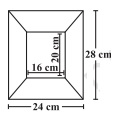
Solution:
Divide given figure into 4 parts, as shown below:
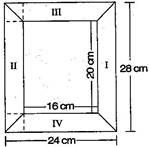
Here two of the given figures (I) and (II) are similar in dimensions.
And also, figures (III) and (IV) are similar in dimensions.
Area of figure (I) = Area of trapezium
\(={1\over 2}×(a+b)×h\)
\(= {1\over 2}×(28+20)×4\)
\(= {1\over 2}×48×4 = 96\)
Area of figure (I) \(= 96 \text{cm}^2\)
Also, Area of figure (II) \(= 96 \text{cm}^2\)
Now, Area of figure (III) = Area of trapezium
\(={1\over 2}\times(a+b)×h\)
\(={1\over 2}\times(24+16)4\)
\(={1\over 2}\times40\times 4 = 80\)
Area of figure (III) is \(80 \text{cm}^2\)
Also, Area of figure (IV) = \(80 \text{cm}^2\)


0 Comments