
1. A survey was made to find the type of music that a certain group of young people liked in a city.
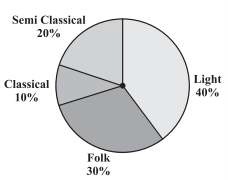
An adjoining pie chart shows the findings of this survey. From this pie chart, answer the following:
(i) If 20 people liked classical music, how many young people were surveyed?
(ii) Which type of music is liked by the maximum number of people?
(iii) If a cassette company were to make 1000 CDs, how many of each type would they
make?
Solution:
(i) 10% represents 100 people.
=20% represents = \({(100×20)\over 10} = 200\)
∴ 200 people were surveyed.
(ii) Since 40% of the total people surveyed liked light music and no other form of song was liked more than that, we can conclude that light music is liked by the maximum number of people.
(iii) CDs of classical music = \({(10 × 1000)\over 100} = 100\)
CDs of semi-classical music = \({(20 × 1000)\over 100} = 200\)
CDs of light music = \({(40 × 1000)\over 100} = 400\)
CDs of folk music = \({(30 × 1000)\over 100} = 300\)
2. A group of 360 people were asked to vote for their favourite season from the three:
seasons rainy, winter and summer.
(i) Which season got the most votes?
(ii)Find the central angle of each sector.
(iii) Draw a pie chart to show this information

Solution:
(i) According to the table given in the question, the winter season got the most votes.
(ii) Central angle of summer season= \({(90^\circ×360^\circ)\over360^\circ}= 90^\circ\)
Central angle of rainy season= \({(120^\circ×360^\circ)\over360^\circ}= 120^\circ\)
Central angle of winter season=\({ (150^\circ×360^\circ)\over360^\circ}= 150^\circ\)
(iii)

3. Draw a pie chart showing the following information. The table shows the colours preferred by a group of people.

Solution:
Here, central angle = 360o Total number of people = 36


4. The adjoining pie chart gives the marks scored in an examination by a student in Hindi, English, Mathematics, Social Science and Science. If the total marks obtained by the students were 540, answer the following questions.
(i) In which subject did the student score 105 marks?
(Hint: for 540 marks, the central angle = 360°. So, for 105 marks, what is the central angle?)
(ii) How many more marks were obtained by the student in Mathematics than in Hindi?
(iii) Examine whether the sum of the marks obtained in Social Science and Mathematics is more than that in Science and Hindi (Hint: Just study the central angles).

Solution:

(i) The student scored 105 marks in Hindi.
(ii) Marks obtained in Mathematics = 135
Marks obtained in Hindi = 105
Difference = 135 – 105 = 30
Thus, 30 more marks were obtained by the student in Mathematics than in Hindi.
(iii) The sum of marks in Social Science and Mathematics = 97.5 + 135 = 232.5
The sum of marks in Science and Hindi = 120 + 105 = 225
∴ The sum of the marks in Social Science and Mathematics is more than in Science and Hindi.
5. The number of students in a hostel speaking different languages is given below. Display the data in a pie chart.

Solution:


.png)

0 Comments