
NCERT Solutions For Class 8 Ex 5.3
ncert solutions for class 8 maths chapter 6, Exercise 5.3 involve complete answers for each question in the exercise 5.3. The solutions provide students a strategic methods to prepare for their exam. Class 8 Maths Chapter 8 Squares and Square Roots Exercise 5.3 questions and answers helps students to perform better in exam and it will clear doubts definitely. Students will find it extremely easy to understand the questions and learn solving the problems. NCERT Solutions for Class 8 Maths Chapter 8 Squares and Square Roots Exercise 5.3 prepared by our subject matter experts in very delicate, easy and creative way.1. What could be the possible ‘one’s’ digits of the square root of each of the following numbers?
i. 9801
The unit digit of \(9^2\) is also 1 (i.e., \(9^2 = 81\), whose unit place is 1).
∴ Unit’s digit of the square root of number 9801 is equal to 1 or 9.
ii.99856
Solution
If the unit digit of the given number is 6, then the unit digit of its square is also 6.
Likewise, the unit digit of \(4^2\) is also 6 (i.e., \(4^2 = 16\), whose unit digit is 6).
Hence, the unit digit of the square root of the number 99856 can be either 6 or 4.
iii. 998001
Solution
i.e. \(1^2 = 1\) and \(9^2 = 81\), whose unit digit is 1.
Therefore, the unit digit of the square root of the number 998001 can be either 1 or 9.
iv. 657666025
Solution
The unit digit of the squared number will be 5, if and only if the unit digit of the given number is 5 (i.e., \(5^2 = 25\), whose unit digit is 5).
Hence, the unit digit of the square root of the number 657666025 should be 5.
2. Without doing any calculation, find the numbers which are surely not perfect squares.
i. 153
153⟹ Ends with 3.
Therefore, 153 is not a perfect square
ii. 257
257⟹ Ends with 7
Therefore, 257 is not a perfect square
iii. 408
408⟹ Ends with 8
Therefore, 408 is not a perfect square
iv. 441
441⟹ Ends with 1
Therefore, 441 is a perfect square.
3. Find the square roots of 100 and 169 by the method of repeated subtraction.Solution:
100 – 1 = 99
99 – 3 = 96
96 – 5 = 91
91 – 7 = 84
84 – 9 = 75
75 – 11 = 64
64 – 13 = 51
51 – 15 = 36
36 – 17 = 19
19 – 19 = 0
Here, we have performed subtraction ten times.
\(∴ \sqrt{100} = 10\)
169
169 – 1 = 168
168 – 3 = 165
165 – 5 = 160
160 – 7 = 153
153 – 9 = 144
144 – 11 = 133
133 – 13 = 120
120 – 15 = 105
105 – 17 = 88
88 – 19 = 69
69 – 21 = 48
48 – 23 = 25
25 – 25 = 0
Here, we have performed subtraction thirteen times.
\(∴ \sqrt{169} = 13\)
4. Find the square roots of the following numbers by the Prime Factorisation Method.
Solution:
i. 729

729 = (3×3)×(3×3)×(3×3)
729 = (3×3×3)×(3×3×3)
\(729 = (3×3×3)^2\)
\(\sqrt{729} = \sqrt{(3×3×3)^2 }= 27\)
ii. 400

400 = 2×2×2×2×5×5×1
400 = (2×2)×(2×2)×(5×5)
400 = (2×2×5)×(2×2×5)
\(400 = (2×2×5)^2\)
\(\sqrt{400} = \sqrt{(2×2×5)^2} = 20\)

1764 = (2×2)×(3×3)×(7×7)
1764 = (2×3×7)×(2×3×7)
\(1764 = (2×3×7)^2\)
\(\sqrt{1764} = \sqrt{( 2 ×3×7)^2} = 42\)
iv. 4096

4096 = 2×2×2×2×2×2×2×2×2×2×2×2
4096 = (2×2)×(2×2)×(2×2)×(2×2)×(2×2)×(2×2)
4096 = (2×2×2×2×2×2)×(2×2×2×2×2×2)
\(4096 = (2×2×2×2×2×2)^2\)
\(\sqrt{4096} = \sqrt{(2×2×2 ×2×2×2)^2} = 64\)

7744 = 2×2×2×2×2×2×11×11×1
7744 = (2×2)×(2×2)×(2×2)×(11×11)
7744 = (2×2×2×11)×(2×2×2×11)
\(7744 = (2×2×2×11)^2\)
\(\sqrt{7744} = \sqrt{(2×2×2×11)^2} = 88\)
vi. 9604
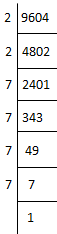
9604 = 62 × 2 × 7 × 7 × 7 × 7
9604 = ( 2 × 2 ) × ( 7 × 7 ) × ( 7 × 7 )
9604 = ( 2 × 7 ×7 ) × ( 2 × 7 ×7 )
\(9604 = ( 2×7×7 )^2\)
\(\sqrt{9604} =\sqrt{( 2×7×7)^2} = 98\)
vii. 5929

5929 = (7×7)×(11×11)
5929 = (7×11)×(7×11)
\(5929 = (7×11)^2\)
\(\sqrt{5929} = \sqrt{(7×11)^2} = 77\)
viii. 9216

9216 = 2×2×2×2×2×2×2×2×2×2×3×3×1
9216 = (2×2)×(2×2) × ( 2 × 2 ) × ( 2 × 2 ) × ( 2 × 2 ) × ( 3 × 3 )
9216 = ( 2 × 2 × 2 × 2 × 2 × 3) × ( 2 × 2 × 2 × 2 × 2 × 3)
9216 = 96 × 96
\(\sqrt{9216} = \sqrt{( 96 )^2} = 96\)
ix. 529
529 = 23×23
\(\sqrt{529} =\sqrt{(23)^2}= 23\)
x. 8100
8100 = 2×2×3×3×3×3×5×5×1
8100 = (2×2) ×(3×3)×(3×3)×(5×5)
8100 = (2×3×3×5)×(2×3×3×5)
8100 = 90×90
\(\sqrt{8100} =\sqrt{(90)^2}=90\)
Solution:
i. 252

252 = 2×2×3×3×7
= (2×2)×(3×3)×7
Here, 7 cannot be paired.
∴ We will multiply 252 by 7 to get the perfect square.
New number = 252 × 7 = 1764
1764 = 2×2×3×3×7×7
1764 = (2×2)×(3×3)×(7×7)
\(1764 = (2×3×7)^2\)
\(\sqrt{1764} = \sqrt{(2×3×7)^2} = 42\)
ii. 180
180 = 2×2×3×3×5
= (2×2)×(3×3)×5
Here, 5 cannot be paired.
∴ We will multiply 180 by 5 to get the perfect square.
New number = 180 × 5 = 900
900 = 2×2×3×3×5×5×1
900 = (2×2)×(3×3)×(5×5)
\(900 = 2^2×3^2×5^2\)
\(900 = (2×3×5)^2\)
\(\sqrt{900} = \sqrt{(2×3×5)^2} = 30\)
iii. 1008

1008 = 2×2×2×2×3×3×7
= (2×2)×(2×2)×(3×3)×7
Here, 7 cannot be paired.
∴ We will multiply 1008 by 7 to get the perfect square.
New number = 1008×7 = 7056
7056 = 2×2×2×2×3×3×7×7
7056 = (2×2)×(2×2)×(3×3)×(7×7)
\(7056 = 2^2×2^2×3^2×7^2\)
\(7056 = (2×2×3×7)^2\)
\(\sqrt{7056} = \sqrt{(2×2×3×7)^2} = 84\)
iv. 2028

2028 = 2×2×3×13×13
= (2×2)×(13×13)×3
Here, 3 cannot be paired.
∴ We will multiply 2028 by 3 to get the perfect square. New number = 2028×3 = 6084
6084 = 2×2×3×3×13×13
6084 = (2×2)×(3×3)×(13×13)
\(6084 = 2^2×3^2×13^2\)
\(6084 = (2×3×13)^2\)
\(\sqrt{6084} = \sqrt{(2×3×13)^2} = 78\)
v. 1458

1458 = 2×3×3×3×3×3×3
= (3×3)×(3×3)×(3×3)×2
Here, 2 cannot be paired.
∴ We will multiply 1458 by 2 to get the perfect square. New number = 1458 × 2 = 2916
2916 = 2×2×3×3×3×3×3×3
2916 = (3×3)×(3×3)×(3×3)×(2×2)
\(2916 = 3^2×3^2×3^2×2^2\)
\(2916 = (3×3×3×2)^2\)
\(\sqrt{2916} = \sqrt{(3×3×3×2)^2} = 54\)
vi. 768

768 = 2×2×2×2×2×2×2×2×3
= (2×2)×(2×2)×(2×2)×(2×2)×3
Here, 3 cannot be paired.
∴ We will multiply 768 by 3 to get the perfect square.
New number = 768×3 = 2304

2304 = 2×2×2×2×2×2×2×2×3×3
2304 = (2×2)×(2×2)×(2×2)×(2×2)×(3×3)
2304 = 22×22×22×22×32
\(2304 = (2×2×2×2×3)^2\)
\(\sqrt{2304} = \sqrt{(2×2×2×2×3)^2} = 48\)
6. For each of the following numbers, find the smallest whole number by which it should be divided so as to get a perfect square. Also, find the square root of the square number so obtained.
i).252
252 = 2×2×3×3×7
= (2×2)×(3×3)×7
Here, 7 cannot be paired.
∴ We will divide 252 by 7 to get the perfect square. New number = 252 ÷ 7 = 36
36 = 2×2×3×3
⇒ 36 = (2×2)×(3×3)
\(36 = 2^2×3^2\)
\( 36 = (2×3)^2\)
\(\sqrt{36} = 2×3 = 6\)
ii.2925
2925 = 3×3×5×5×13
= (3×3)×(5×5)×13
Here, 13 cannot be paired.
∴ We will divide 2925 by 13 to get the perfect square. New number = 2925 ÷ 13 = 225
225 = 3×3×5×5
⇒ 225 = (3×3)×(5×5)
\( 225 = 3^2×5^2\)
\(225 = (3×5)^2\)
⇒ \(\sqrt{36} = 3×5 = 15\)
iii.396
396 = 2×2×3×3×11
= (2×2)×(3×3)×11
Here, 11 cannot be paired.
∴ We will divide 396 by 11 to get the perfect square. New number = 396 ÷ 11 = 36
36 = 2×2×3×3
⇒ 36 = (2×2)×(3×3)
\(36 = 2^2×3^2\)
\(36 = (2×3)^2\)
⇒ \(\sqrt{36} = \sqrt{(2 \times 3)} = 6\)
iv.2645
2645 = 5×23×23
⇒ 2645 = (23×23)×5
Here, 5 cannot be paired.
∴ We will divide 2645 by 5 to get the perfect square.
New number = 2645 ÷ 5 = 529
529 = 23×23
⇒\( 529 = (23)^2\)
⇒ \(\sqrt{529} = 23\)
v. 2800
2800 = 2×2×2×2×5×5×7
= (2×2)×(2×2)×(5×5)×7
Here, 7 cannot be paired.
∴ We will divide 2800 by 7 to get the perfect square. New number = 2800 ÷ 7 = 400
400 = 2×2×2×2×5×5
⇒ 400 = (2×2)×(2×2)×(5×5)
\(400 = (2×2×5)^2\)
\(\sqrt{400} = 20\)
vi.1620
1620 = 2×2×3×3×3×3×5
= (2×2)×(3×3)×(3×3)×5
Here, 5 cannot be paired.
∴ We will divide 1620 by 5 to get the perfect square. New number = 1620 ÷ 5 = 324
324 = 2×2×3×3×3×3
⇒ 324 = (2×2)×(3×3)×(3×3)
⇒ \(324 = (2×3×3)^2\)
⇒ \(\sqrt{324} = 18\)
7. The students of Class VIII of a school donated Rs 2401 in all, for Prime Minister’s National Relief Fund. Each student donated as many rupees as the number of students in the class. Find the number of students in the class.
Solution:
∴ Each student donates Rs x.
Total amount contributed by all the students\(= x×x=x^2 \)

\(x^2 = (7×7)×(7×7)\)
\(x^2 = 49×49\)
\(x = \sqrt{(49×49)}\)
\( x = 49\)
∴ The number of students = 49
Solution:
Let the number of rows be x.
∴ the number of plants in each row = x.
Total plants to be planted in the garden \(= x × x = x^2\)
\(x^2 = 2025\)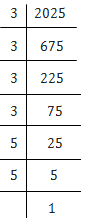
\(x^2 = 3×3×3×3×5×5\)
\(x^2 = (3×3)×(3×3)×(5×5)\)
\(x^2 = (3×3×5)×(3×3×5)\)
\(x^2 = 45×45\)
\(x = \sqrt{45×45}\)
\(x = 45\)
∴ The number of rows = 45, and the number of plants in each row = 45.
9. Find the smallest square number that is divisible by each of the numbers 4, 9 and 10.
Solution:
LCM of 4, 9 and 10 is (2×2×9×5) 180.
180 = 2×2×9×5
= (2×2)×3×3×5
= (2×2)×(3×3)×5
Here, 5 cannot be paired.
Therefore, we will multiply 180 by 5 to get the perfect square.
Hence, the smallest square number divisible by 4, 9 and 10 = 180×5 = 900
10. Find the smallest square number that is divisible by each of the numbers 8, 15 and 20.
Solution:
LCM of 8, 15 and 20 is (2×2×5×2×3)=120.
120 = 2×2×3×5×2
= (2×2)×3×5×2
Here, 3, 5 and 2 cannot be paired.
∴ We will multiply 120 by (3×5×2) 30 to get the perfect square.
Hence, the smallest square number divisible by 8, 15 and 20 =120×30 = 3600


0 Comments