
NCERT Solutions for Class 9 Math Chapter 12 statistics for Exercise 12.1
we have solved the NCERT Solutions for Class 9 Math Chapter 12 statistics for Exercise 12.1 in a very easy manner. Students can easily grab the topic as updated for new academic year. HP Board Students can also use these solutions for there board exams. NCERT Solutions for 9th Maths Chapter 12, Exercise 12.1 involve complete answers for each question in the exercise 12.1. The solutions provide students a strategic methods to prepare for their exam. Class 9 Maths Chapter 12 statistics exercise 12.1 questions and answers helps students to perform better in exam and it will clear doubts definitely. Students will find it extremely easy to understand the questions and learn solving the problems.NCERT Solutions for Class 9 Maths Chapter 12 statistics prepared by www.skmath.in team in very delicate, easy and creative way.
1. A survey conducted by an organisation for the cause of illness and death among the women between the ages 15 – 44 (in years) worldwide found the following figures (in %):
(i) Represent the information given above graphically.
(ii) Which condition is the major cause of women’s ill health and death worldwide?
(iii) Try to find out, with the help of your teacher, any two factors which play a major role in the cause in (ii) above being the major cause.
Solution:
(i) The information given in the question is represented below graphically.
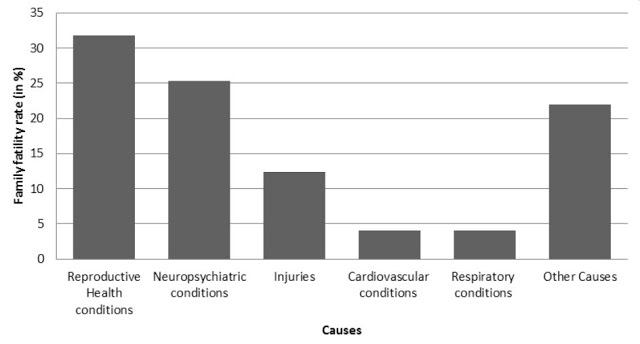
(ii) We can observe from the graph that reproductive health conditions are the major cause of women’s ill health and death worldwide.
(iii) Two factors responsible for the cause in (ii) are
- Lack of proper care and understanding.
- Lack of medical facilities.
2. The following data on the number of girls (to the nearest ten) per thousand boys in different sections of Indian society are given below.
(i) Represent the information above by a bar graph.
(ii) In the classroom, discuss what conclusions can be arrived at from the graph.
Solution:
(i) The information given in the question is represented below graphically.

(ii) From the above graph, we can conclude that the maximum number of girls per thousand boys is present in section ST. We can also observe that the backward districts and rural areas have more girls per thousand boys than non-backward districts and urban areas.
3. Given below are the seats won by different political parties in the polling outcome of state assembly elections:
(i) Draw a bar graph to represent the polling results.
(ii) Which political party won the maximum number of seats?
Solution:
(i) The bar graph representing the polling results is given below.
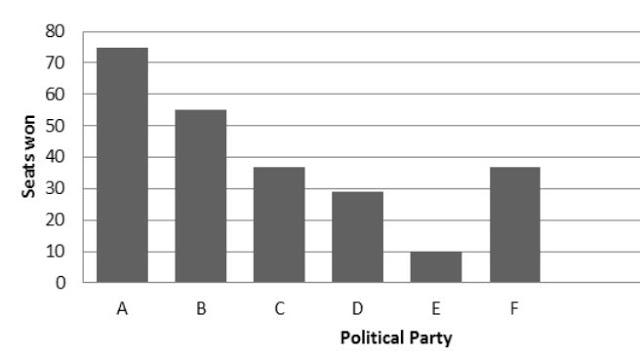
(ii) From the bar graph, it is clear that Party A won the maximum number of seats.
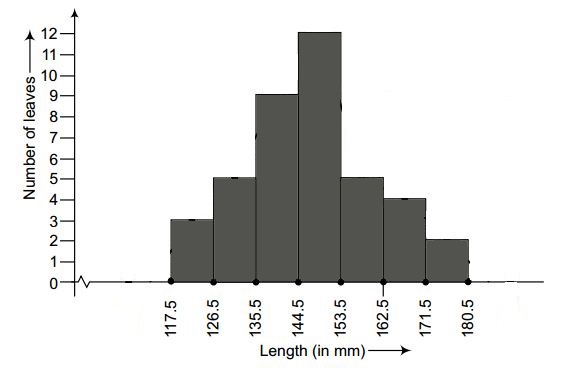
4. The length of 40 leaves of a plant is measured correctly to one millimetre, and the obtained data is represented in the following table:
(i) Draw a histogram to represent the given data. [Hint: First, make the class intervals continuous.]
(ii) Is there any other suitable graphical representation for the same data?
(iii) Is it correct to conclude that the maximum number of leaves is 153 mm long? Why?
Solution:
(i) The data given in the question is represented in the discontinuous class interval. So, we have to make it in the continuous class interval. The difference is 1, so taking half of 1, we subtract ½ = 0.5 from the lower limit and add 0.5 to the upper limit. Then, the table becomes
(ii) Yes, the data given in the question can also be represented by a frequency polygon.
(iii) No, we cannot conclude that the maximum number of leaves is 153 mm long because the maximum number of leaves are lying in-between the length of 144.5 – 153.5
5. The following table gives the lifetimes of 400 neon lamps.
(i) Represent the given information with the help of a histogram.
(ii) How many lamps have a lifetime of more than 700 hours?
Solution:
(i) The histogram representation of the given data is given below.
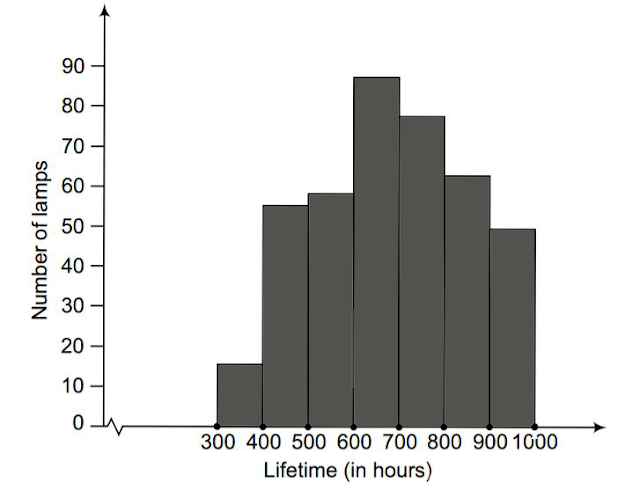
(ii) The number of lamps having a lifetime of more than 700 hours = 74+62+48 = 184
6. The following table gives the distribution of students in two sections according to the marks obtained by them.
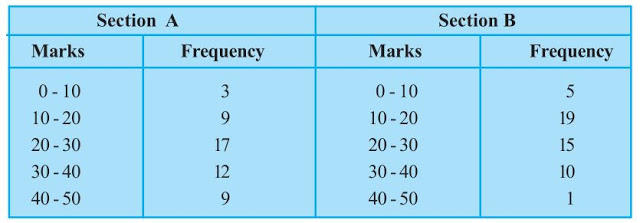
Represent the marks of the students of both sections on the same graph by two frequency polygons. From the two polygons, compare the performance of the two sections.
Solution:
The class-marks = (lower limit + upper limit)/2
For section A,
For section B,
Representing these data on a graph using two frequency polygon, we get

From the graph, we can conclude that the students of Section A performed better than Section B.
7. The runs scored by two teams, A and B, on the first 60 balls in a cricket match are given below.
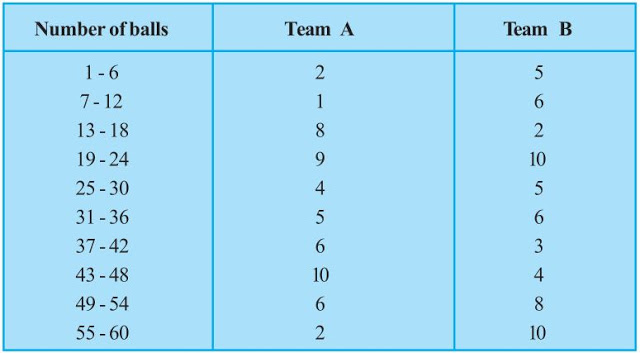
Represent the data of both teams on the same graph by frequency polygons.
[Hint: First, make the class intervals continuous.]
Solution:
The data given in the question is represented in the discontinuous class interval. So, we have to make it in the continuous class interval. The difference is 1, so taking half of 1, we subtract ½ = 0.5 = 0.5 from the lower limit and add 0.5 to the upper limit. Then, the table becomes
The data of both teams are represented on the graph below by frequency polygons.

8. A random survey of the number of children of various age groups playing in a park was found as follows:
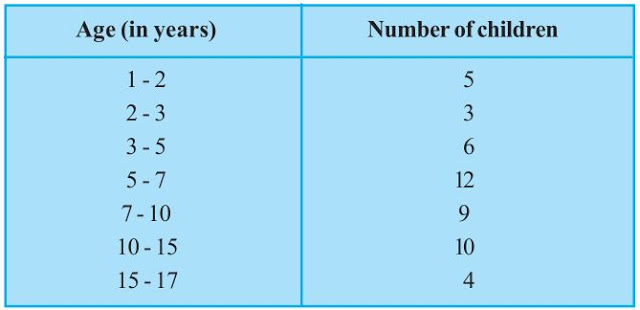
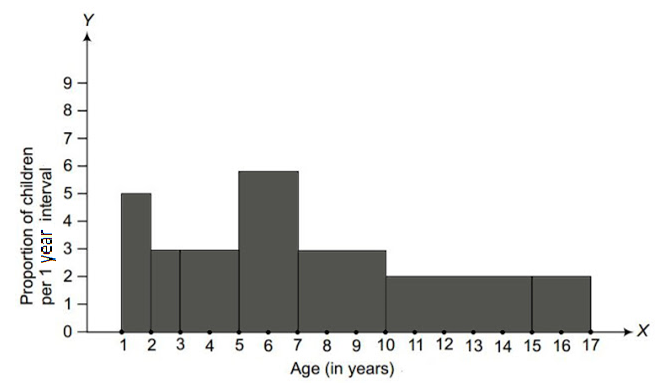
Draw a histogram to represent the data above.
Solution:
The width of the class intervals in the given data varies.
We know that,
The area of the rectangle is proportional to the frequencies in the histogram.
Thus, the proportion of children per year can be calculated as given in the table below.
Let x-axis = the age of children
y-axis = proportion of children per 1-year interval
9. 100 surnames were randomly picked up from a local telephone directory, and a frequency distribution of the number of letters in the English alphabet in the surnames was found as follows:
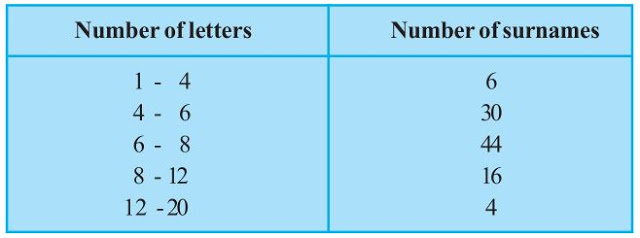
(i) Draw a histogram to depict the given information.
(ii) Write the class interval in which the maximum number of surnames lie.
Solution:
(i) The width of the class intervals in the given data is varying.
We know that,
The area of the rectangle is proportional to the frequencies in the histogram.
Thus, the proportion of the number of surnames per 2 letters interval can be calculated as given in the table below.
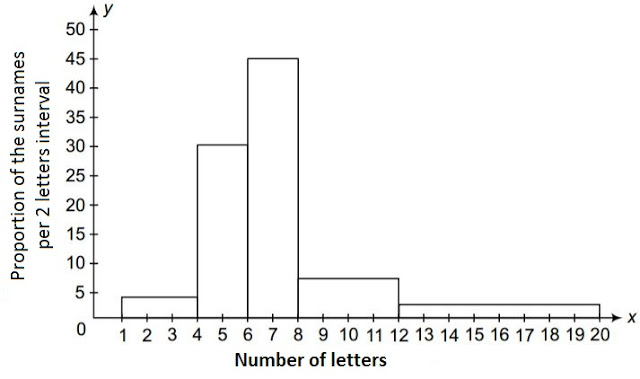
(ii) 6-8 is the class interval in which the maximum number of surnames lie.


.png)

0 Comments